Western Alliance Veterans Dental Program
Catholic Charities Community Services Arizona launched the Western Alliance Veterans Dental Program at MANA House, our 76-bed transitional housing program for veterans experiencing homelessness in Phoenix. Through an innovative partnership with the Western Alliance Community Foundation and AzDA Cares Foundation, the program integrates comprehensive dental care into MANA House’s continuum of services, ensuring residents have access to preventive, restorative, and emergency dental treatment at no cost.
Recognizing that oral health is a critical yet often overlooked factor in achieving long-term stability, the program removes financial, transportation, and access barriers that can prevent veterans from securing employment and permanent housing. By coordinating individualized dental care alongside case management, employment assistance, and housing support, MANA House is helping veterans restore their health, confidence, and dignity while strengthening their path toward self-sufficiency and long-term housing stability.
Challenge or Need
Many veterans experiencing homelessness arrive at MANA House with significant unmet oral health needs that have gone untreated for years. While they are working to overcome housing instability, unemployment, and other challenges, dental care is often inaccessible due to cost, limited insurance coverage, or lack of transportation. Nationally, more than 75% of Veterans Health Administration enrollees are not eligible for dental benefits, leaving many veterans without access to even basic preventive care.
Untreated dental disease affects far more than physical health. Chronic pain, missing or damaged teeth, and visible oral health issues can diminish self-confidence, hinder successful job interviews, and create barriers to employment, ultimately impacting a veteran’s ability to achieve lasting independence. Yet dental care has historically been outside the scope of traditional housing programs.
MANA House recognized that addressing homelessness requires more than providing shelter. To achieve permanent housing stability, veterans need holistic support that removes the underlying obstacles preventing them from rebuilding their lives. The Veterans Dental Program was designed to fill this critical gap by making comprehensive dental care an integrated component of each resident’s individualized plan for success.
By addressing oral health as part of whole-person care, MANA House helps veterans improve their overall well-being while increasing their readiness for employment, restoring confidence, and supporting successful transitions from homelessness to permanent housing.
Why It’s Innovative
The Veterans Dental Program reimagines oral healthcare as a housing stabilization strategy rather than a stand-alone medical service. While many organizations refer clients to outside providers, MANA House created a coordinated model that fully integrates dental care into its continuum of services for veterans experiencing homelessness.
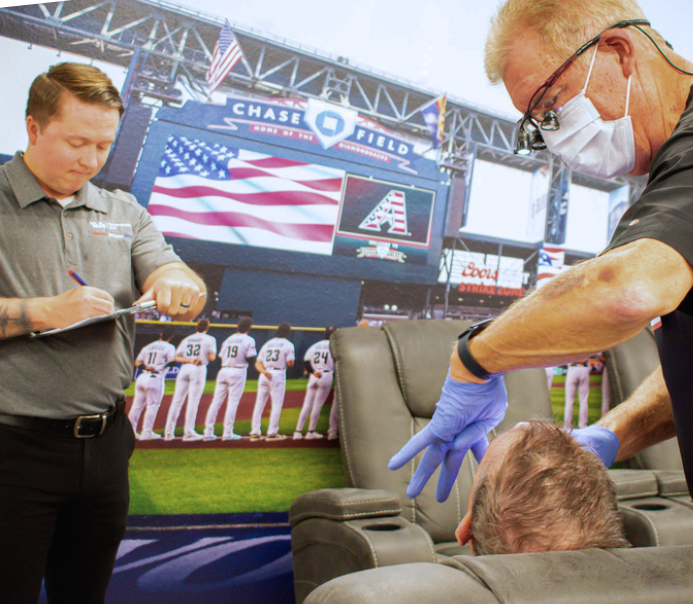
The initiative brings together partners from the nonprofit, philanthropic, and healthcare sectors in a shared commitment to improving veteran outcomes. Catholic Charities identifies veterans’ needs, coordinates care through individualized case management, and removes logistical barriers such as transportation. The Western Alliance Community Foundation provided catalytic funding to launch the initiative, while AzDA Cares Foundation coordinates a network of participating dental professionals who deliver preventive, restorative, and emergency care.
This collaborative approach recognizes that restoring a veteran’s smile can also restore confidence, improve health, strengthen employability, and increase the likelihood of achieving long-term housing stability. Rather than treating dental care as an optional support service, MANA House has embedded it into a proven transitional housing model that addresses the whole person.
Rooted in the belief that every person possesses inherent dignity, the initiative addresses the whole person—not just the immediate need for shelter.
The program offers a practical, replicable framework that other Catholic Charities agencies and homeless service providers can adapt by leveraging local healthcare partners to address a frequently overlooked barrier to self-sufficiency and permanent housing.
Program Impact
Thirty-eight veterans were screened by six dentists at our kick-off screening day. The total spent so far on veterans at MANA House is $41,383.01.
Twenty Veterans were seen and received the following procedures:
- 20 exams and x-rays
- 25 fillings and one 3-unit bridge and one six-unit bridge
- 4 emergency exams by participating dentists
- 5 denture sets or partials and dentures sets
- 50 extractions done by our oral surgeons
- 21 exams done by our participating dentists
- 12 veterans were seen for periodontal services such as prophy and deep scaling root planing procedures
- 3 endodontic consults were done by our endodontist
Results include:
- Improved quality of life. Veterans who had lived with chronic dental pain for years are now receiving treatment that allows them to eat comfortably, sleep better, and improve their overall health
- Increased confidence and dignity. Restoring smiles has helped veterans regain self-confidence, making them feel more comfortable interacting with others and pursuing employment opportunities
- Reduced barriers to employment. Good oral health is often overlooked as a workforce issue. Dental treatment helps veterans feel prepared for interviews and employment by improving both appearance and comfort
- Creation of a replicable public-private partnership. The collaboration between Catholic Charities, Western Alliance Bank, and the Arizona Dental Association Foundation demonstrates how nonprofits, corporate philanthropy, and professional associations can leverage their unique strengths to solve a complex community need.
- Expanded volunteer engagement. The program has provided meaningful opportunities for dentists and dental professionals to use their expertise in service to veterans.
- Raised awareness of oral health disparities among unhoused veterans. Media coverage and community conversations have highlighted that dental care is often one of the greatest unmet healthcare needs for veterans experiencing homelessness or housing instability.
- Demonstrated the value of comprehensive supportive services. Stable housing alone isn’t enough. Addressing healthcare needs is an important component of helping veterans achieve long-term stability.
Lessons Learned
- Develop referral pathways before launch. Having participating dentists, transportation, consent forms, case management procedures, and scheduling processes established beforehand helps maintain momentum after screening events.
- Assign a dedicated program coordinator. Someone who can actively coordinate among veterans, dentists, transportation providers, and case managers to keep participants engaged throughout treatment.
- Collect baseline data early. Establishing metrics from day one makes it easier to demonstrate impact to funders and recruit additional partners.
- Meet veterans where they are. Flexibility is essential. Communication methods, appointment scheduling, and follow-up often need to be adapted to each individual’s circumstances.
- Trust is built before treatment. Many veterans have experienced trauma or long periods without healthcare. Building rapport significantly improves participation.
- Expect changing circumstances. Veterans may obtain employment, move into permanent housing, change phone numbers, or leave the shelter during treatment. The program should be designed with flexibility to accommodate these transitions.
- Prepare volunteer dentists for the population they will serve. Brief orientation regarding trauma-informed care, behavioral health challenges, military culture, and barriers faced by unhoused veterans improves both the provider and patient experience.
- Simplify participation for dental practices. Clear referral processes, reimbursement procedures, and a single point of contact encourage more dentists to volunteer.
- Corporate partners can be catalysts. Funding from a corporate partner like Western Alliance Bank not only provided financial resources but also brought credibility that helped recruit additional healthcare partners.
- Transportation should be considered part of healthcare. Even the best clinical partnerships are ineffective if participants cannot reliably get to appointments.
- No single organization could have accomplished this alone. The program succeeds because each partner contributes what they do best: Catholic Charities provides trusted relationships and case management, Western Alliance Bank provides philanthropic investment and community leadership, AzDA Cares recruits dental professionals, and volunteer dentists provide expert clinical care. Together, the partnership creates outcomes that none of the organizations could achieve independently. This initiative isn’t simply about providing dental care. It’s a model for how cross-sector partnerships can address complex challenges facing veterans in a coordinated, compassionate, and sustainable way. That is likely one of the strongest takeaways for other Catholic Charities agencies looking to replicate the program.
In The News