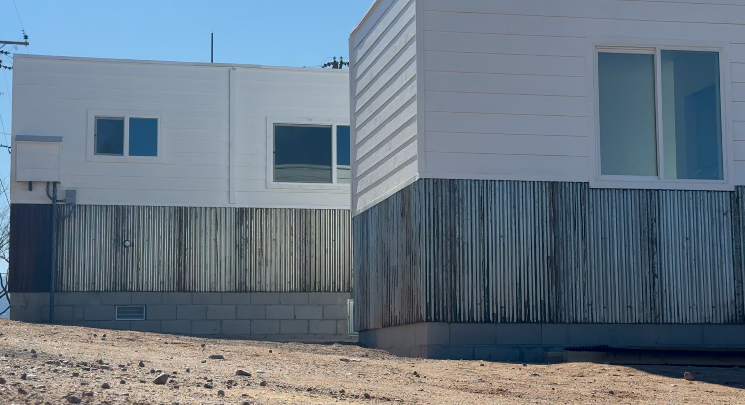
This proposal from Catholic Community Services Southern Arizona concerns an innovative housing initiative for the creation of a micro community located in Sierra Vista, Cochise County, Arizona. The funding will allow us to complete additional units and offer affordable housing without the need for ongoing government subsidies to house people with disabilities, seniors, and low-income families. Those whose income falls under 60% of area median income (AMI) would be able to find housing they can afford.
Upon full completion of the project, the community will feature 20 units of transitional housing, 40 units of low-income housing, an additional 40 units of workforce development housing, and a community resource center, providing much needed resources and services. The effort represents a forward-thinking approach to addressing housing needs in Southern Arizona and has already resulted in strong collaboration between community, municipal, and educational partners.
Challenge or Need
The rate of individuals and families experiencing homelessness continues to increase at near pandemic levels, making it clear that we needed to find an innovative solution to solve homelessness. As there are multiple causes of homelessness and housing instability, CCS partnered with other solutions-minded educational institutions, innovators, and government officials to create a multifaceted approach to this issue.
To assist individuals transition from homeless to stably housed, this project includes a transitional housing project administered in accordance with the Department of Housing and Urban Development’s (HUD) latest directives. For individuals on a fixed income, this project creates units they can afford to live in, without the need for an ongoing subsidy, and it creates workforce development housing for low-income individuals and families who are working but cannot afford their rent. This project also leverages Medicaid funds to ensure residents receive intensive wraparound support services to improve the factors contributing to their instability (social determinants of health).
This initiative represents an important and timely effort to address housing instability in Southern Arizona through an integrated approach that combines design research, community engagement, and implementation strategies. The proposed project includes transitional, affordable, and workforce housing, and reflects the expanded understanding of housing as part of a broader ecosystem of care, resilience, and community support for those with disabilities, veterans, seniors, and low-income families.
Why It’s Innovative
This project is beneficial to taxpayers as it directly addresses housing instability, veteran homelessness, and vulnerability among low-income, senior, and disabled communities by providing permanent supportive housing, transitional units, and workforce-compatible residences. It does all of this within a coordinated continuum of care (COC) framework. The proposed project aligns with HUD’s national objective of benefit to low-and moderate income (LMI) people through the creation of affordable housing units and on-site supportive services targeted to households below 60% AMI without the need for ongoing government subsidy. Catholic Community Services of Southern Arizona has managed over 10,000 federal, state, and county grants and contracts in its 93 years of existence, with more than 113 active grants and contracts from federal, state, county, and city entities throughout Southern Arizona. CCS currently operates a COC program in Cochise County
Program Impact
Catholic Community Services of Southern Arizona (CCS) has been providing transitional housing services in Southern Arizona since 1997. In 2024, CCS made the decision to revamp its Transitional Housing Program to include a mandate for participation in services. Participants are required to: maintain sobriety, actively engage in case management services, follow their service plan, work and/or attend school, attend monthly financial literacy courses, save 10% of their discretionary income, and pay 10% of their discretionary income towards debts identified on their credit report.
CCS had the forethought to track program performance data in the Homeless Management Information System (HMIS), to be able to effectively compare program outcomes against Rapid Rehousing Programs. CCS Transitional Housing Program is proud of the fact that our program boasts a 99% success rate with zero returns to homelessness within six months, compared to the national average of 70-80% success rate for Rapid Rehousing, including 10% of individuals returning to homelessness within six months. CCS has demonstrated the ability to institute these requirements in a supportive environment, where program participants feel respected, encouraged, and motivated to achieve their goals.
Lessons Learned
As a licensed Medicaid provider that specializes in providing intensive wraparound support services to individuals currently, or previously, experiencing homelessness, CCS utilizes best practices in trauma-informed care, motivational interview, and housing-based case management to help participants achieve stability in all areas of their lives. CCS administers a person-centered comprehensive assessment to identify all areas of need in the participant’s life, creates a strengths-based individualized service plan to create goals to address those needs, identifies the interventions needed to achieve the goals, and coordinates efforts with medical and behavioral health providers, educational/vocational institutions, employment services, and other providers to improve these social determinants of health.
As registered Community Assistors, CCS ensures participants receive all eligible public assistance needed to attain and maintain stability. CCS leverages Medicaid reimbursement for the support services provided to participants, as well as other federal, state, and philanthropic funds to pay for staffing costs and other expenses (educational fees, vocational training, employment resources, transportation, etc.) that hinder participants’ progress towards achieving their goals. CCS provides life skills training, health promotion, and community engagement services to teach participants how to maintain independent living. The project’s approach will provide housing stability through the construction of microhomes and community facilities integral to housing stabilization and reintegration.
In the news: