The Rapid Emergency Shelter Implementation Framework is an agile crisis-response housing model capable of constructing, staffing, and opening fully operational emergency shelters within a strict two-week window. Pioneered by Catholic Charities, Diocese of St. Petersburg, this scalable blueprint has successfully deployed three distinct crisis shelters across our region. Rather than relying on traditional, slow-moving brick-and-mortar development, the framework utilizes flexible and durable physical footprints, ranging from immediate emergency tents to climate-controlled, hurricane-resistant, modular “Hope Cottages.” By combining pre-established local government partnerships with a lean operational staffing structure, this framework bridges the immediate gap between acute community trauma and permanent housing stabilization. It achieves this while maintaining a remarkably low daily operational cost that is optimized per-resident and ensures long-term financial sustainability for massive client populations.
Challenge or Need
Traditional emergency housing and transitional shelter systems require extensive development cycles, complex zoning timelines, and massive capital expenditures. When a sudden public emergency strikes, vulnerable populations are left exposed because the traditional infrastructure response moves too slowly. This program was intentionally engineered to dismantle those bottlenecks and address three catastrophic, intersecting crises that rapidly accelerated homelessness across the Diocese of St. Petersburg:
- Severe regional affordable housing shortages exacerbated by widespread financial downturns.
- The urgent, sudden need for isolated, de-intensified shelter alternatives during the COVID-19 pandemic shelter-in-place mandates.
- The sudden influx of hundreds of individuals left completely unhoused following devastating, major hurricanes that ravaged our coastal communities.
In each scenario, the prevailing community challenge was time. Displaced individuals faced the compounding trauma of losing their stability, safety, and access to basic human needs. Concurrently, our agency faced severe resistance from community NIMBYism (“Not In My Backyard”), local zoning hurdles, and fluctuating funder requirements. The framework was explicitly designed to bypass these systemic delays, providing immediate, dignified shelter while simultaneously providing the target population with comprehensive, on-site, wraparound medical, clinical, and case-management support.
Why It’s Innovative
The true innovation lies in shifting the paradigm of emergency shelter from a fixed, permanent infrastructure to an agile, modular response network that prioritizes extreme adaptability and aggressive cost-efficiency.
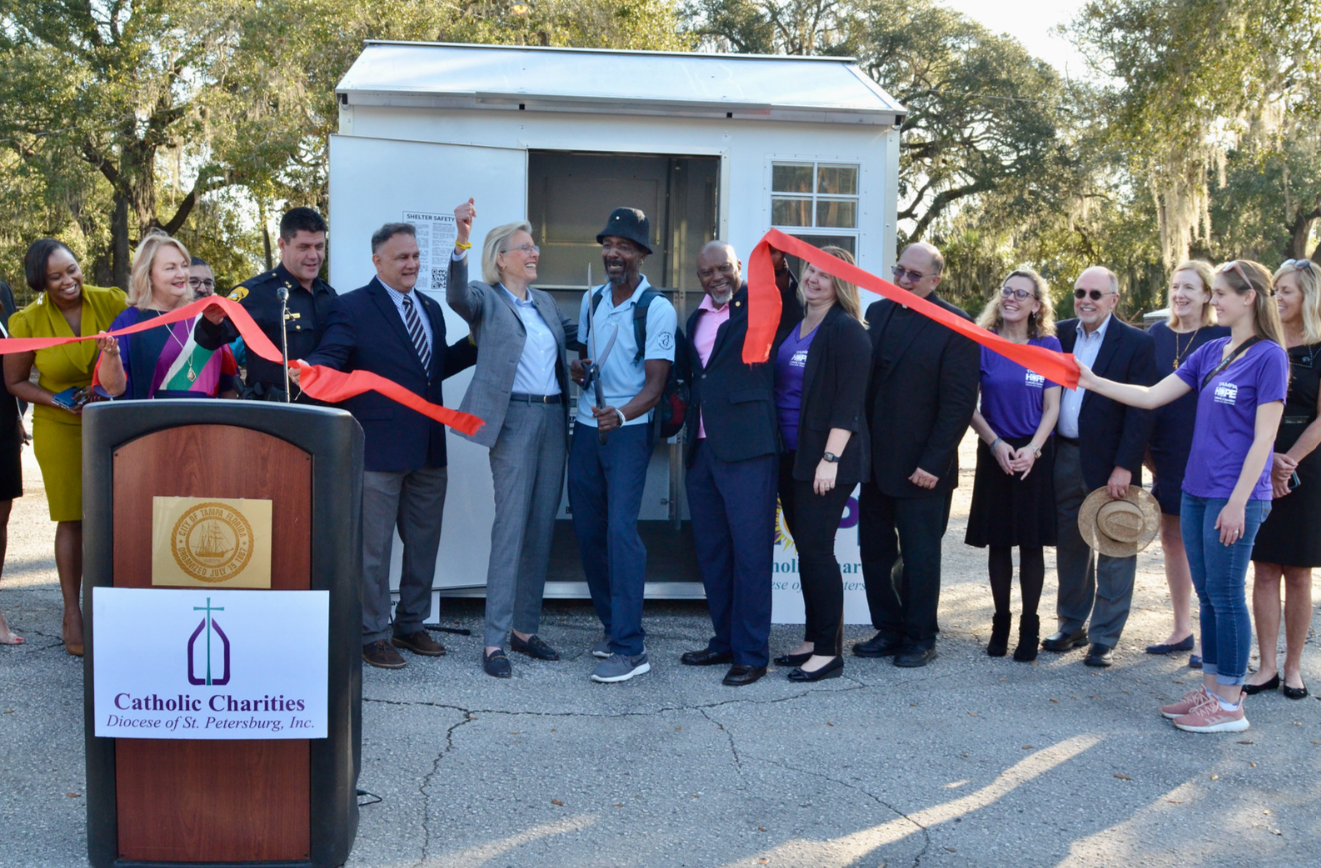
First, our architectural approach is highly creative: we pioneered the use and deployment of individual, air-conditioned, hurricane-certified “Hope Cottages.” This design offers a multi-level improvement over traditional tents, providing locks, privacy, and safety from category-four winds at a fraction of standard construction costs and timelines.
Second, our operational strategy reimagines site selection and community alignment. Instead of fighting municipal friction, we actively integrate local government participation from day one, leveraging county- or diocesan-owned land, securing emergency public subsidies, and cultivating local business partnerships to secure donated food and supplies.
Finally, our business model drastically increases the return on investment (ROI) in the nonprofit space. We built a scalable organizational structure utilizing a lean blend of core staff and temporary emergency personnel. By structuring clear data tracking and rigorous SMART goals directly into the framework, we maintain complete operational and policy independence while meeting strict funder criteria.
We proved that an agency can serve a massive, expanding population at a minimal, optimized per-resident, per-day cost, setting a new national benchmark for affordable, rapid crisis sheltering.
Program Impact
The quantitative and qualitative impact of this rapid-response framework has been profound across our five-county footprint. Most notably, our agency successfully compressed the standard months-long shelter implementation pipeline down to an unprecedented two-week launch window, opening doors when our neighbors needed shelter most.
Through these combined rapid implementations, our agency’s emergency shelter network successfully served more than 4,600 unique individuals in the past year alone. Operationally, our flagship emergency disaster site was scaled to serve more than 12,000 individuals in just two months. More importantly, our established homeless shelters serving those suffering from substance use disorder, mental health diagnoses, and/or chronic homelessness have an average success rate of 45%, with residents achieving verified positive outcomes, including successfully graduating into stable income sources and permanent housing.
Environmentally and structurally, our modular Hope Cottages achieved massive, long-term fiscal efficiency, reducing annual tent maintenance and replacement costs from $40,000 to a stabilized $17,500 annual depreciation expense, allowing us to redirect critical funds directly into resident wraparound care. Financially, the initiative successfully optimized operations to maintain a highly minimized daily cost-per-resident footprint, providing millions of meals and safe nights of shelter without draining agency reserves.
Lessons Learned
We have surfaced several critical, battle-tested insights that any Catholic Charities agency can replicate to enhance its crisis resilience.
Build the Coalition Before the Crisis: Relationships with local businesses, parish networks, and municipal officials must be cultivated before disaster strikes. Pre-establishing these networks allowed us to instantly clear land-use obstructions and bypass NIMBYism when rapid site selection became mandatory.
Standardize Policies and SMART Goals Early: Rapid implementation can easily become chaotic without a rigid internal infrastructure. Developing pre-written policies and procedures and embedding data tracking from the first hour ensures flawless data, public compliance, and the agency’s complete ideological and policy independence even under strict federal or local funding guidelines.
Prioritize Scalable Infrastructure: Tents provide immediate, day-one relief, but transitioning quickly to durable, innovative structures like modular shipping containers vastly increases long-term ROI, enhances client self-esteem, protects residents from secondary disasters (like severe weather), and drastically reduces annual maintenance overhead.
Lean Staffing Models Prevent Burnout: Structure your organization with a flexible core team that can quickly onboard temporary emergency staff to meet sudden surges, ensuring that baseline services remain uncompromised during rapid expansion.
In The News