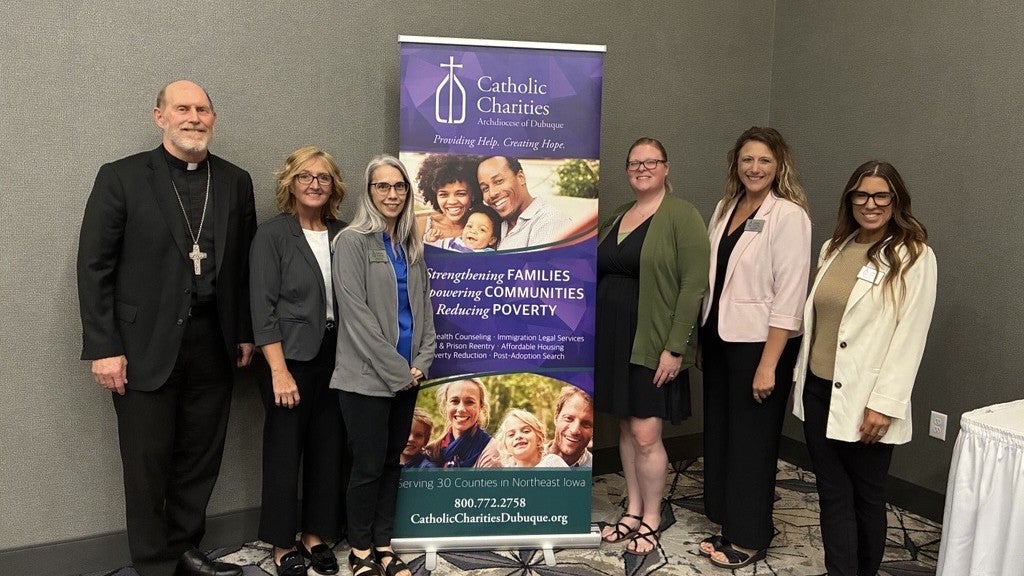
Catholic Charities agencies gather to share wisdom on prison reentry programs
Some are former law enforcement. Others, probation officers. One has an adult son currently in prison, and another spent years in foster care as a child after his mother was jailed.
What they all have in common is a shared passion for prison ministry and reentry work, which they believe is fundamentally about human dignity.
“We call it a program, but I always keep ministry in mind, because that’s really what it is,” said Karen Hoeger, reentry services coordinator for Catholic Charities Archdiocese of Dubuque, Iowa.
Earlier this month, CC Dubuque hosted about two dozen staffers from 14 agencies and Catholic Charities USA at a two-day gathering for people working in this ministry or whose agencies are considering starting a program. It was organized by Jane Stenson, vice president for food and nutrition/poverty reduction strategies at CCUSA. Participants came from as far away as Buffalo, New York, and Santa Rosa, California.
A former probation officer in Colorado, Hoeger and a colleague, Katie Harn, split the archdiocese between them and work with about 45 active volunteers to support people journeying from addiction to health and wholeness.
“What does successful reentry look like?” asked Catholic Charities Dubuque Executive Director Tracy Morrison. “It takes an entire community to provide what is needed. It is ensuring that an individual’s worst day is not how they are defined forever.”
A corporal work of mercy
Catholic Charities staffers came to the gathering with differing levels of experience in prison ministry and reentry work. Some were asked to share their wisdom with the group, while others took notes to bring back to their agencies, either in hopes of bolstering an existing program or creating one because the need is there. There was animated conversation about funding, whether from the state or grants or even the national opioid settlement.
Dubuque Archbishop Thomas Zinkula shared his enthusiasm for the work. A regular visitor to Anamosa State Penitentiary in Iowa, where he offers Mass on Christmas and Easter mornings and several other times throughout the year, he was a lawyer before he was a priest.
He has welcomed incarcerated men into the Catholic Church and encouraged those assembled to be realistic about the barriers to performing this ministry, but to remember “the hope that says these barriers do not have the last word.”
Isaac Landsteiner is the director of parish social ministry at Catholic Charities of Southern Minnesota, where they are trying to engage more volunteers. A former seminarian, he ministered at one time at a federal prison hospital, which left a deep impression on him. He believes the community interest is there.
“I get calls from people all the time asking to do this corporal work of mercy,” and visit the imprisoned, he said.
Catholic Charities of the Diocese of Green Bay offers reentry support to returning citizens, including meals, job training, and a thrift store. It falls under their Human Dignity and Life program, where Joshua Richards is an advocate.
Previously a corrections officer, he felt called to more meaningful work in part because of his own life experiences. His mother was incarcerated for 18 months when he was a child, and he spent five years in foster care as a result. There were no reentry services available to his mom, which led the family, once finally reunited, to struggle financially and become homeless at times.
“I’m hopeful that the more we can restore people’s dignity, the less likely they are to go back to prison,” Joshua said.
Deacon John Cord, who will retire soon from the prison ministry program at Catholic Charities Indianapolis, said the diaconate is a great resource generally for prison ministry and reentry programs, as are parishes. “Those people incarcerated in those facilities are your parishioners,” he said his archbishop likes to remind priests in Indianapolis. “So treat them like it.”
Judy Kroshus directs Battle Born Recovery Residences, a sober living facility of Catholic Charities of Northern Nevada in Reno that can house up to 100 men. They receive case management and pay a nominal rent while they save money for life after completing the program, which generally takes 12 to 18 months. “We have a huge amount of accountability,” she said, and few relapses among graduates.
The throughline in all of these programs is community and dignity.
A robust reentry program
Catholic Charities Dubuque’s program offers mentoring to nonviolent drug offenders who are participating in one of five state drug courts—now more commonly called rehabilitation courts—throughout the Archdiocese of Dubuque. A combination of public health and public safety approaches, it is offered to those on probation who are deemed good candidates for treatment and rehabilitation and who would otherwise be facing incarceration.
It takes about 15 to 18 months to complete the program, which entails drug testing, community service, finding housing and employment, and meeting regularly with a Catholic Charities mentor one-on-one or with a COSA group (Circles of Support and Accountability). There is no timeframe; rather, advancement through its five phases is based on goal completion.
The post-program success rate for participants is staggering: upwards of 75 percent. That means three-quarters will not reoffend, and a significant reason for that is the support they receive both from the rehabilitation court staff—the judge, probation officer, mental health provider, defense attorney, and prosecutor—and their Catholic Charities mentor or COSA group.
Hoeger and Hart, and as well as their volunteer mentors, make regular visits to rehabilitation court to support their mentees through the process. The experience was a highlight of the two-day gathering.
The COSA group is modeled after the restorative justice practices of indigenous peoples. “It’s community support to repair harm,” Hoeger said. “We use it as a way to support people on their journey as we encourage them to be healthier. Because if they’re healthier, our community is healthier.”
Court is in session
On the first Tuesday morning in August, rehabilitation court in Mason City, Iowa, was in full swing. All participants, whether newbies in phase one or those nearing completion in phase five, assemble as a group once a month. It has the feel of a revival meeting, as the 14 participants greet each other and their mentors in attendance, as well as the court staff, who know them all by name. It’s a courtroom, but it is not a staid affair. Participants sit in what would otherwise be a jury box.
There are several rehabilitation court graduates in attendance, there to offer moral support. One has brought her newborn son. Another has been sober since 2022 and is now a Catholic Charities mentor. There is no prohibition against having a criminal record in becoming a mentor. In fact, staff ask, who better?
Once court is in session, the judge begins with phase five participants, who have been there the longest. They offer synopses of their jobs, their “give back” or community service hours—at thrift stores or community parks—and how they’re feeling about their lives more broadly. The judge picks a question for each: What do you recognize now as your triggers? How has being clean changed your life? He addresses them by name and references past exchanges and milestones. He notes that one man, historically of few words, comes out of his shell describing the train car he is helping to restore. It’s of such interest, he has exceeded his give back hours on the project.
Those with perfect attendance get a standing ovation. Those who’ve had good weeks get entered in a monthly drawing for gift cards. One woman talks about her impulse control and having recently spent a few weeks quietly reflecting on her challenges, i.e., back in jail. Another woman cuts her ankle monitor off, an early inflection point in the program. They are all tested for drug use, but a slip-up does not mean expulsion. In fact, it is not unexpected for those who are newer to the program.
The sense of community is palpable, both from participants and from those in the courtroom who are there to support them. One woman cited her COSA group and credited it with keeping her on track.
Affording people the basic dignity of learning their names and not treating them like criminals—or literally calling them by their prison numbers—is foundational to this work, as the judge demonstrated by example, time and again, throughout the morning.
“So much depends on the judge,” said Harn, “whether they’re stern or work with people.”
Lucky Tovey, a program manager at Catholic Charities of Kansas City–St. Joseph in Missouri, helps people with criminal records learn soft social skills and find employment as they reintegrate into the community. She liked what she saw in court.
“Calling people by their first name is huge,” she said.
With a sociology background and family members who have struggled with addiction and had brushes with the legal system, Lucky feels called to this work, as do many of those gathered.
“It’s dear to my heart,” she said.
Story by Julie Bourbon, senior writer at Catholic Charities USA.