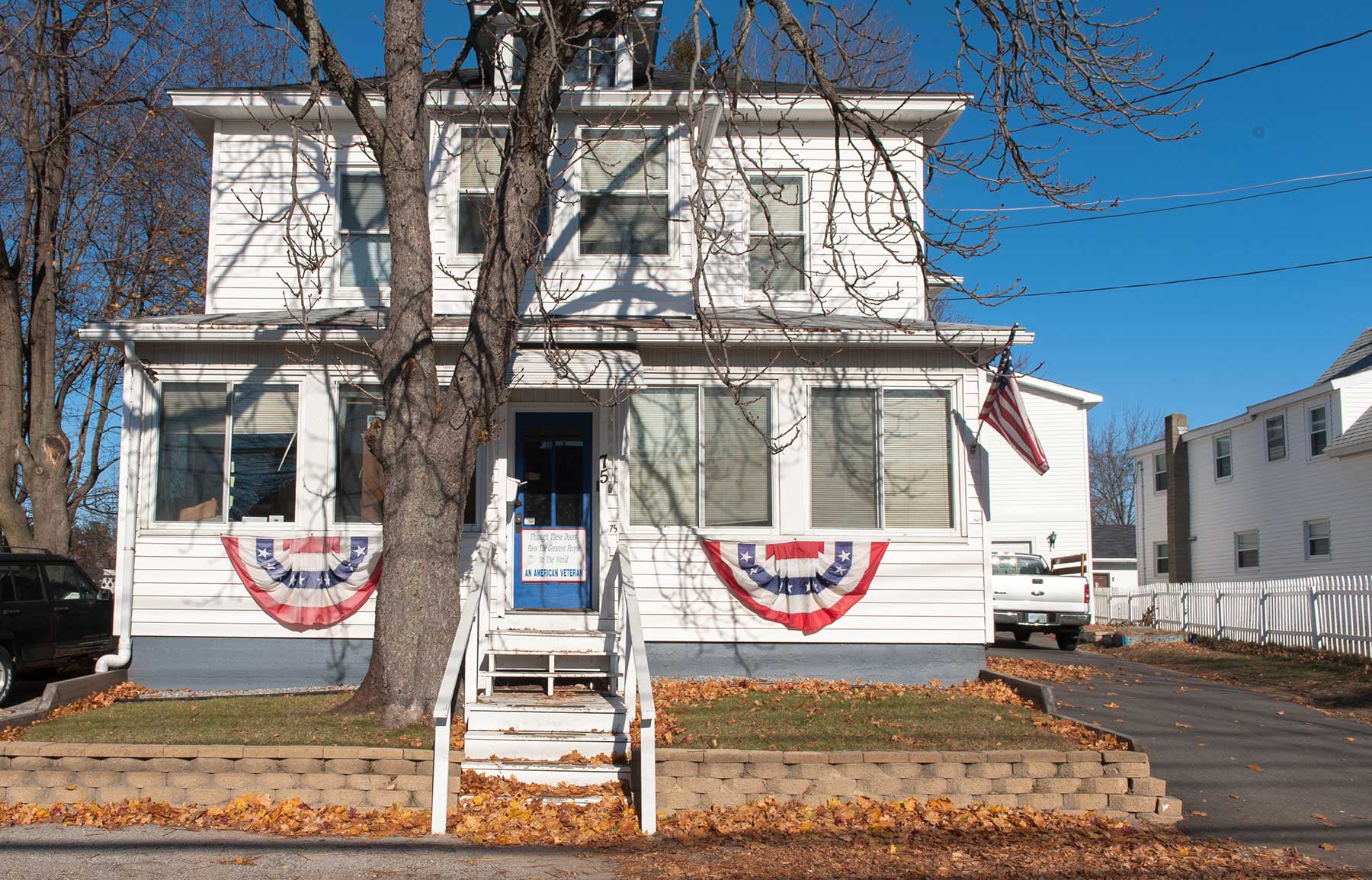
Liberty House is a sober transitional living program from Catholic Charities New Hampshire for veterans experiencing homelessness, substance use disorders, post-traumatic stress, and other challenges. As the only program of its kind in New Hampshire, it combines safe housing with a proven four-step program that helps veterans achieve lasting stability.
Beyond housing, Liberty House provides intensive case management, individualized recovery plans, and strong community partnerships. Each resident follows a personalized path focused on recovery, wellness, employment, and permanent housing.
A key feature is the program’s mandatory escrow savings model, which helps residents build financial stability before moving into independent housing.
Liberty House also operates a community pantry, providing food, clothing, transportation assistance, and other essentials to veterans throughout the region.
Since expanding into a larger facility in 2021, Liberty House has doubled its residential capacity, allowing it to serve significantly more veterans across New Hampshire
Challenge or Need
Many veterans return home carrying the invisible wounds of military service, including substance use disorders, post-traumatic stress, depression, traumatic brain injuries, and other challenges. These struggles can make it incredibly difficult to successfully reintegrate into civilian life, often leading to cycles of unstable housing, unemployment, and financial hardship.
Combined with a growing shortage of affordable housing, rising living costs, and other economic pressures, more veterans are experiencing homelessness or are at risk of becoming homeless.
While emergency shelters provide immediate safety, veterans in recovery frequently struggle to find substance-free environments that support lasting independence. Those who are not eligible for certain VA benefits may have even fewer options.
Liberty House fills this critical gap. The program provides veterans with stable housing while addressing the underlying causes of homelessness through recovery support, case management, financial readiness, and community connections.
Before arriving at Liberty House, residents have often been sleeping in vehicles, couch surfing, cycling through shelters or treatment programs, or leaving prisons and jails. In 2025, one-third of residents were considered chronically homeless. Without programs like Liberty House, many would continue cycling through homelessness, addiction, hospitalization, or incarceration rather than achieving lasting stability.
Why It’s Innovative
Liberty House does more than provide transitional housing. It offers a proven pathway to independence that integrates recovery, health, employment, financial readiness, and housing into one coordinated model.
The four-step program is at the core of the model, supporting each resident’s self-directed path to independence. Designed specifically for veterans, particularly those recovering from substance use disorders, the model provides a clear framework from the day a resident enters Liberty House until he transitions into stable housing.
These steps include:
- Rediscovering Purpose: Residents work with a licensed alcohol and drug counselor and follow individualized recovery plans that support long-term sobriety.
- Health and Wellness Connections: Staff help residents obtain essential documents—including birth certificates, Social Security cards, and driver’s licenses—while reconnecting them with primary care physicians, dentists, and mental health providers. Since 2022, 100% of residents have reestablished primary care, 91% secured dental care, and 100% obtained health insurance.
- Meaningful Employment: Staff help residents obtain sustainable employment that provides the financial stability needed to successfully transition into independent living.
- Transition to Independence: Residents secure safe, affordable housing while building financial stability through an escrow savings program, with 50% of earned income reserved for security deposits, moving expenses, and other housing costs.
The program emphasizes action-oriented behaviors. We expect sustained effort from our residents throughout their stay with us, beginning with the residents’ two-week probationary period and continuing until they successfully complete the program.
Program Impact
Through the program, veterans gain the support they need to rebuild their lives and move toward lasting stability. In 2025 alone, the program:
- Housed 44 veterans through its transitional living program.
- Provided 5,740 nights of safe housing.
- Successfully graduated 30 residents into greater independence.
- Distributed more than 51,700 food, clothing, and household items through its community pantry.
The long-term outcomes have been equally significant. Since 2022:
- 100% of residents obtained critical identification documents.
- 100% established a bank account.
- 96% secured permanent housing.
- 87% obtained a driver’s license.
These results demonstrate that Liberty House is not simply helping veterans overcome an immediate housing crisis. It is helping them rebuild the foundation for long-term independence, purpose, and stability.
Lessons Learned
One of our biggest lessons is that successful transitional housing means more than providing a safe place to stay. Lasting change happens when housing is combined with a structured roadmap, individualized support, and measurable milestones.
Liberty House’s four-step program creates consistency for both staff and residents while allowing each veteran’s plan to remain individualized. The model promotes accountability, enabling residents to address recovery, health, employment, finances, and housing simultaneously rather than sequentially.
We’ve also learned the importance of investing in financial readiness before residents transition into permanent housing. Our escrow savings model helps veterans leave with resources for deposits, moving expenses, and emergencies while building lifelong financial habits.
We believe this structured, mission-focused model can be adapted by other Catholic Charities agencies serving veterans or other populations experiencing homelessness. It provides a replicable framework that strengthens long-term outcomes while remaining flexible enough to meet local community needs.
In the news