The Feeding Our Neighbors (FON) program from Catholic Charities of the Archdiocese of New York works to reduce hunger and poverty among at-risk children, seniors, and adults. Food is often an important gateway through which we can help individual clients and communities to also access other essential resources. We strive to achieve a standard level of performance among our food pantries and soup kitchens in three distinct ways: (1) we provide healthy food assistance to our network of food programs, (2) we provide quality social services to support individuals and families, and (3) we provide innovative programmatic assistance to help programs meet the needs of their community. The following are the key components of our FON program.
Challenge or Need
The FON program addresses food insecurity among New Yorkers struggling to meet basic needs by directly administering five food pantries and supporting a network of 30 food programs, most run out of individual parishes. According to the Robin Hood Poverty Tracker Annual Report Vol. 8 (2026), the city’s poverty rate reached 26% in 2024, representing approximately 2.2 million residents, including 450,000 children—the highest level recorded in over a decade and roughly double the national average.
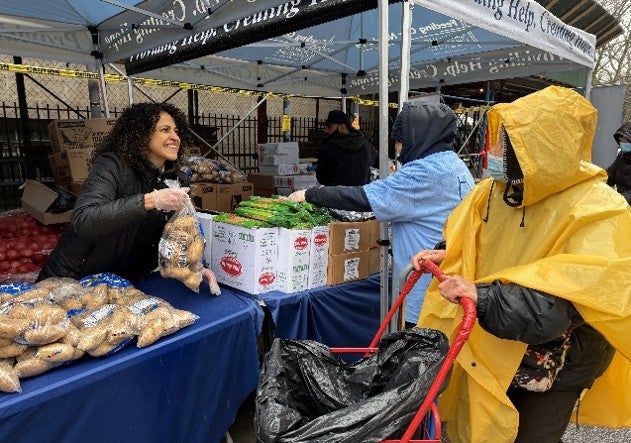
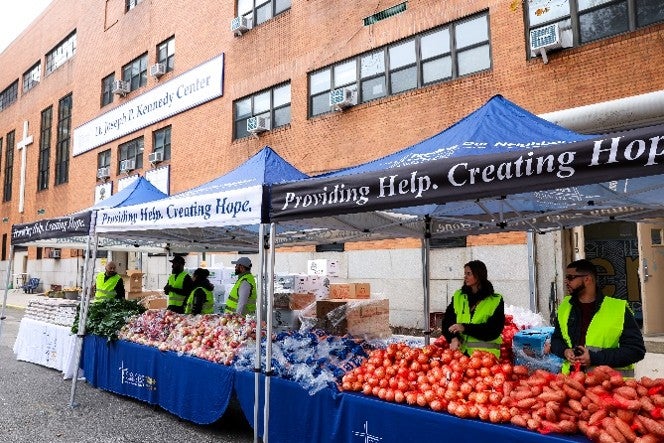
Catholic Charities Community Services of New York’s (CCCS) pop-up pantries and mobile distributions are solutions we added during the pandemic to expand access to food beyond the reach of our network of pantries, and they have become an important part of our emergency food offering.
Nutrition classes and cooking demonstrations are newer programmatic additions born out of the reality that economically challenged families often face chronic health conditions due to overreliance on cheaper, processed foods and unhealthy eating habits. At first, it took some convincing to get people to attend these classes. Now, we even have to turn participants away due to the high demand, and we regularly receive requests for more frequent classes from the communities we serve.
Our Bronx Hub was created to address the challenge of coordinating services and in-kind food donations among our broad network of food pantries and soup kitchens located at parishes and community centers throughout the Archdiocese of New York. It allows us to receive donations in a centralized location, track inventory, and pass those along to our network of 35 food programs.
Why It’s Innovative
FON’s innovation lies in its integrated approach to food security. Below are some of its innovative initiatives.
CCCS operates a network of five directly administered pantries and provides technical assistance, in-kind food support, volunteer coordination, and funding to 30 partner pantries and soup kitchens. This collaborative model expands access to nutritious food while helping community-based partners better serve their neighborhoods.
Beyond traditional pantry services, FON has expanded to include mobile pantries (pre-packed bags) and pop-up pantries (green market style) that bring nutritious food directly to underserved neighborhoods. We also offer weekend pantry hours for households unable to access services during the work week.
Nutrition education: Food insecurity is not only about whether food is available, but also about the nutritional value of that food. When resources are limited, healthy foods are often the first items families are forced to forgo. Our food selection process prioritizes dietary value and includes nutritious items such as eggs, meat, milk, cheese, and fresh and canned produce.
Earlier this year, CCCS launched an in-house nutrition workshop and cooking demonstration initiative aimed at educating our neighbors about healthier lifestyles. This initiative helps individuals better understand the connection between food and health in terms of preventing chronic illnesses.
To address evolving federal SNAP (Supplemental Nutrition Assistance Program) regulations, in addition to our SNAP outreach team, CCCS is in the process of creating a dedicated SNAP manager position to coordinate outreach, guide clients through new eligibility and work requirements, and connect individuals with workforce development and volunteer opportunities.
Program Impact
The goal of FON is to combat hunger and poverty by providing emergency food assistance while also addressing other underlying issues to help individuals build pathways toward longer-term stability.
The impact of these efforts is measured by tracking and reporting on a range of performance metrics, including number of households served, meals provided, clients gaining access to SNAP benefits, referrals provided, case management services provided, and other key indicators. FON uses two client database systems: Exponent Case Management, which tracks client information and services delivered, and Plentiful, which is used to record data on meals and clients served.
In FY2025, the program distributed more than 5.8 million meals to approximately 56,000 unique households. Through our SNAP outreach team, we processed nearly 1,500 new applications for SNAP benefits in addition to over 900 recertifications.
From September through May of the current fiscal year, FON distributed over 7.5 million meals, served 68,747 unique households, and assisted 2,334 individuals with SNAP benefits, a significant increase from the previous year. This growth comes at a time when CCCS experienced a reduction in funding from the federally supported Emergency Food and Shelter Program.
These results reflect the strength of the FON program and the generous commitment of our partners and funders. Despite reductions in emergency food funding and rising demand, we have expanded mobile and pop-up pantry services, increased SNAP outreach, launched in-house nutrition classes, and continued supporting a network of 35 food pantries to ensure that New Yorkers can access nutritious food and essential benefits.
A professionally produced video will help us share this impact with current and prospective funders. This will increase awareness of the program and help secure the resources needed to sustain and grow these essential food services as we navigate the funding challenges and uncertainties ahead in 2027.
Lessons Learned
One of our biggest lessons has been the value of building a coordinated food network rather than relying on a single service model. By supporting 30 partner pantries in addition to operating our own food pantries, we are able to share our expertise, technical assistance, food resources, volunteer coordination, and funding with neighborhoods that may not have the same capacity. This strengthens the emergency food system as a whole and extends our reach into communities across New York.
We have also learned that food assistance is most effective when it is paired with other wraparound services. Combining emergency food distribution with SNAP outreach, nutrition education, case management, mobile and pop-up pantries, and other CCCS services (such as eviction prevention) allows us to address both immediate food needs and other underlying challenges that contribute to long-term food insecurity.
Finally, we have learned that adaptability is essential. As community needs, funding, and public benefit policies continue to change, we must be able to respond effectively while maintaining strong communication with clients, community partners, and funders. For example, during the disruption in SNAP benefits in November 2025, we expanded our operations to include weekend food distributions in high-need communities to help families facing immediate uncertainty. In response to new SNAP work requirements for able-bodied adults without dependents (ABAWD), we are establishing a dedicated SNAP position to help clients navigate changing regulations and maintain access to benefits. We are also working on strengthening our workforce development efforts to connect participants with employment, training, and volunteer opportunities that support longer-term stability.
As many other Catholic Charities agencies across the country work in the area of food insecurity in some capacity, we hope that sharing the innovative aspects of our own, successful emergency food programming may help generate ideas to better address food insecurity in other communities.